Medical Services
The Largest online database of patient reviews for doctors, facilities and online Appointment.


A subspeciality of cardiology
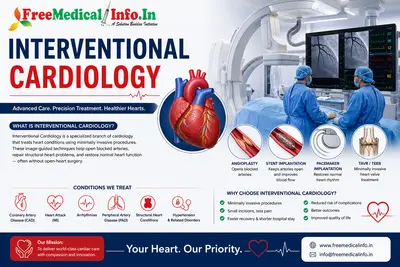
called interventional cardiology uses minimally invasive catheter-based
techniques to diagnose and treat cardiovascular disorders. Interventional
cardiologists use tiny tubes called catheters that are put through blood
vessels, typically the wrist or groin, to access the heart and blood vessels
rather than doing conventional open-heart surgery. These cutting-edge methods
greatly enhance patient results, shorten recuperation times, and lower surgical
risks.
Coronary angioplasty and
stent implantation are among the most frequently performed procedures in interventional
cardiology. This medication treats coronary artery disease, which occurs
when plaque accumulates and blocks or restricts the coronary arteries. A stent
is inserted to maintain the artery open throughout the surgery, and a
tiny balloon is inflated inside the artery to restore blood flow. This method
reduces the risk of heart attacks, enhances circulation, and
efficiently eliminates chest pain.
Emergency cardiac
care also heavily relies on interventional cardiology. To promptly
restore blood flow to the heart muscle, patients suffering from acute heart
attacks frequently need urgent angioplasty. Quick action can greatly improve
survival rates and avoid serious heart damage. With the use of cutting-edge
imaging technology, modern cardiac catheterisation labs enable experts
to perform accurate and potentially life-saving procedures.
Interventional cardiologists
use catheter-based techniques to address structural heart problems in addition
to coronary artery treatments. Major surgery is frequently unnecessary
to cure conditions like congenital heart abnormalities, heart valve diseases,
and septal flaws. For high-risk or elderly patients, safer
options include procedures such as mitral valve repair, transcatheter
aortic valve replacement (TAVR), and closure of atrial septal defects.
Another crucial component of
interventional cardiology is peripheral vascular procedures. These
treatments narrow or block the blood channels outside the heart,
including the arteries supplying the legs, kidneys, and brain. Effective
therapy lessens pain, improves blood circulation, and prevents issues like
stroke or limb damage.
Interventional cardiology is
still changing due to technological developments. Intravascular
ultrasonography, optical coherence tomography, rotating atherectomy, and
robotically assisted procedures are examples of contemporary methods. These
developments increase safety, improve procedure accuracy, and provide
physicians more confidence while treating complicated cardiovascular
diseases.
In interventional
cardiology, preventive heart care is just as crucial. Cardiologists advise
their patients to lead heart-healthy lifestyles that include regular exercise,
a balanced diet, quitting smoking, managing stress, and getting frequent
checkups. The chance of getting major cardiovascular illnesses can be
considerably decreased by controlling risk factors like high blood
pressure, diabetes, obesity, and high cholesterol.
By providing efficient, less
intrusive treatments for various cardiovascular disorders, interventional
cardiology has transformed contemporary heart care. Patients today enjoy
quicker recovery times, shorter hospital stays, higher quality of life, and
better long-term heart health outcomes thanks to ongoing improvements in
medical technology and treatment methods.
Coronary Artery Conditions Atherosclerosis Chronic Total Occlusion (CTO) Stable Angina Unstable Angina Acute Coronary Syndrome (ACS) Silent Ischemia Left Main Coronary Artery Disease Triple Vessel Disease Restenosis After Angioplasty Heart Attack & Emergency Cardiac Conditions Myocardial Infarction (Heart Attack) ST-Elevation Myocardial Infarction (STEMI) Non-ST Elevation Myocardial Infarction (NSTEMI) Cardiogenic Shock Sudden Cardiac Arrest Coronary Thrombosis Structural Heart Diseases Aortic Stenosis Mitral Valve Stenosis Mitral Regurgitation Tricuspid Valve Disease Pulmonary Valve Stenosis Patent Foramen Ovale (PFO) Atrial Septal Defect (ASD) Ventricular Septal Defect Patent Ductus Arteriosus (PDA) Peripheral Vascular Diseases Peripheral Artery Disease (PAD) Carotid Artery Disease Renal Artery Stenosis Critical Limb Ischemia Deep Vein Thrombosis (DVT) Pulmonary Embolism Aortic Aneurysm Aortic Dissection Rhythm & Electrical Disorders Atrial Fibrillation Atrial flutter Bradycardia Tachycardia Ventricular Tachycardia Ventricular fibrillation (VF) Sick Sinus Syndrome Heart block Congenital Heart Diseases Tetralogy of Fallot Coarctation of Aorta Transposition of Great Arteries Ebstein Anomaly Pulmonary Atresia Congenital Valve Disorders Heart Failure & Muscle Disorders Congestive Heart Failure Dilated Cardiomyopathy Ischaemic cardiomyopathy Hypertrophic Cardiomyopathy Restrictive Cardiomyopathy Hypertension-Related Disorders Resistant Hypertension Pulmonary Hypertension Renovascular Hypertension Valve & Aortic Disorders Calcific Aortic Valve Disease Calcific Aortic Valve Disease Bicuspid Aortic Valve Aortic Regurgitation Mitral Valve Prolapse (MVP) Endocarditis-Related Valve Damage Post-Procedural & Device-Related Conditions In-stent restenosis (ISR) Stent Thrombosis Pacemaker Complications Implantable Cardioverter Defibrillator (ICD) Related Disorders Transcatheter Valve Dysfunction Graft Failure After Bypass Surgery
Book appointments with minimum wait-time & verified doctor details
Interventional Cardiology

Interventional Cardiology
Interventional Cardiology
.webp)
Interventional Cardiology

Interventional Cardiology
Book appointments with minimum wait-time & verified Hospital details

Interventional Cardiology

Interventional Cardiology
Book appointments with minimum wait-time & verified other services
Advertisement

|

|

|

|

|

|

|

|

|

|