Medical Services
The Largest online database of patient reviews for doctors, facilities and online Appointment.


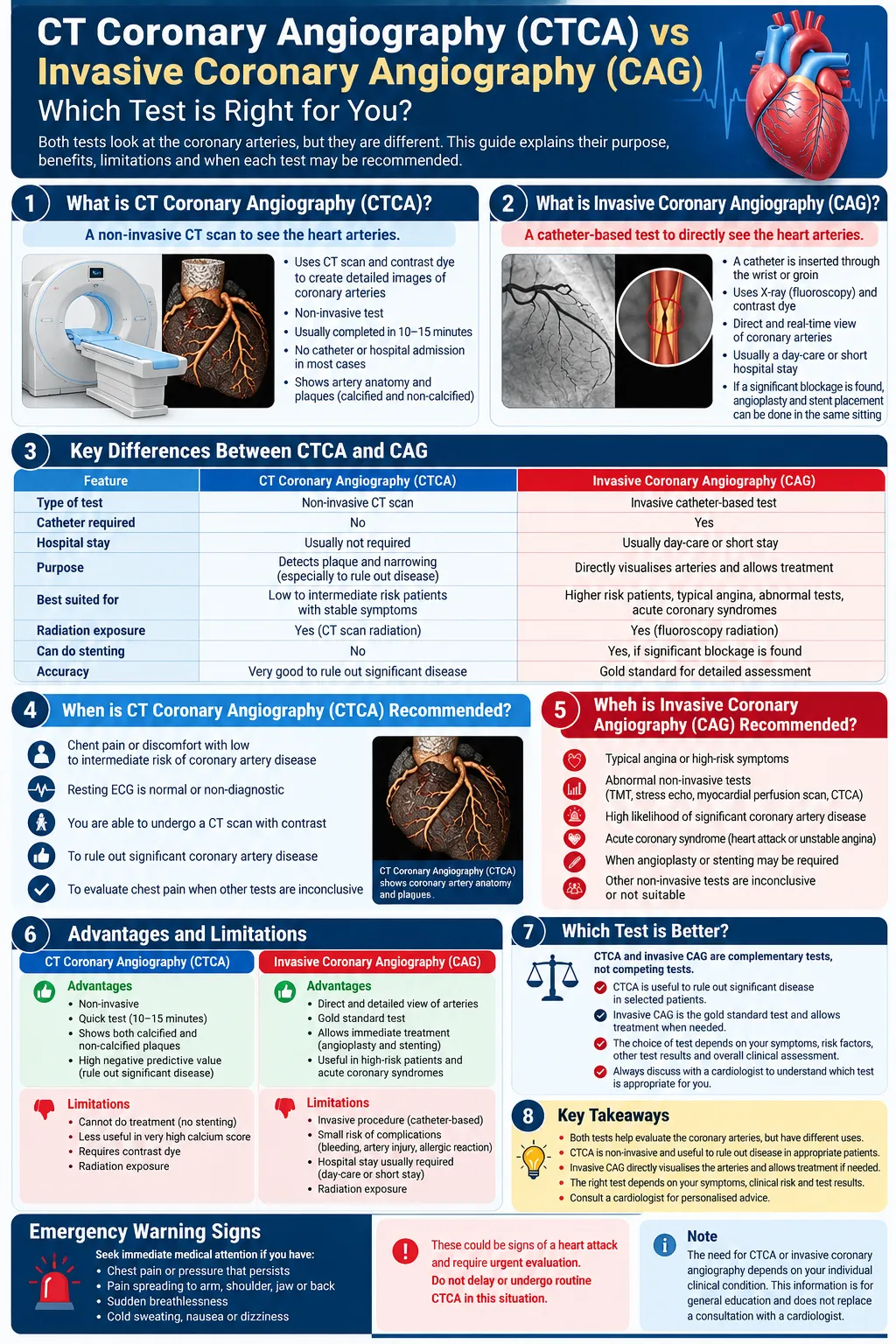
When evaluating possible coronary artery disease, two commonly discussed investigations are CT coronary angiography (CTCA) and invasive coronary angiography (CAG). Both provide information about the heart's arteries, but they differ in how they are performed, what they can establish and whether treatment can be carried out during the same procedure.
Understanding these differences can help patients make informed decisions with their cardiologist.
CT coronary angiography is a non-invasive imaging test that uses a CT scanner and contrast dye injected through a vein to produce detailed images of the coronary arteries. It can identify atherosclerotic plaque and narrowing of the arteries.
CTCA is often useful in patients with stable chest pain who have an appropriate likelihood of coronary artery disease. A normal, good-quality scan can help rule out significant coronary artery disease in suitable patients.
However, extensive coronary calcification, certain heart rhythms, difficulty controlling heart rate, kidney problems or contrast allergy may affect its suitability or image quality.
Invasive coronary angiography is a catheter-based procedure performed in a cardiac catheterisation laboratory. A thin catheter is introduced through an artery, usually at the wrist or groin, and contrast dye is injected to visualise the coronary arteries under X-ray guidance.
It provides detailed information about coronary blockages and is particularly important when the likelihood of significant disease is high, symptoms are concerning or other tests indicate a need for further assessment.
If a significant blockage is found and treatment is appropriate, coronary angioplasty and stent placement may sometimes be performed during the same session.
CTCA may be considered when:
A patient has stable chest discomfort and an appropriate low-to-intermediate likelihood of coronary artery disease.
The diagnosis remains uncertain after initial clinical assessment.
A non-invasive test is suitable for evaluating the coronary arteries.
The clinician wants to assess coronary plaque and anatomy without arterial catheterisation.
CTCA is not appropriate for every patient. The decision depends on symptoms, clinical risk, kidney function, contrast suitability and expected image quality.
Invasive CAG may be recommended when:
There is a high clinical likelihood of significant coronary artery disease.
Symptoms persist despite appropriate medical treatment.
Non-invasive tests suggest high-risk coronary disease.
CTCA is inconclusive or shows findings that require further assessment.
A patient has an acute coronary syndrome, such as a heart attack, where urgent invasive assessment may be necessary.
The timing of angiography in an emergency depends on the clinical presentation and risk. A suspected heart attack requires urgent medical evaluation rather than a routine outpatient CT scan.
CTCA does not require an arterial catheter and is generally performed as an outpatient scan. Invasive CAG involves arterial catheterisation and carries procedural risks, including bleeding and vascular injury, but it allows direct coronary assessment and potentially immediate treatment.
Both tests involve radiation and iodinated contrast. Their risks and suitability depend on the individual patient and the specific clinical circumstances.
Neither test is universally better. The correct choice is the one that answers the clinical question safely and effectively.
No. CTCA is an important non-invasive test, but it cannot replace invasive CAG in every situation. Some patients require invasive assessment because of high-risk symptoms, concerning test results or a need to consider revascularisation.
Likewise, invasive angiography is not necessary for every patient with chest discomfort. Appropriate clinical assessment helps avoid both unnecessary invasive procedures and delays in necessary treatment.
If you have chest discomfort, multiple cardiovascular risk factors or questions about which coronary test is appropriate, consult a qualified cardiologist for an individual assessment.
Dr Ankur Gautam, DM (Cardiology), Senior Consultant and Interventional Cardiologist, provides cardiac consultation at Medical Mantra Multispeciality Clinic in Indirapuram, Ghaziabad, and at KDSG Super Speciality Hospital, Greater Noida West.
The choice between CTCA and invasive CAG should be based on your symptoms, medical history, risk assessment and previous investigation results.
Medical disclaimer: This article is for general educational purposes only and does not replace a personal medical consultation. If you have persistent chest pain, severe breathlessness, cold sweating or other symptoms suggestive of a heart attack, seek emergency medical care immediately.

Blood tests are commonly used to understand different aspects of a person's health. Doctors may recommend them to investigate symptoms, monitor existi... ( Read More )
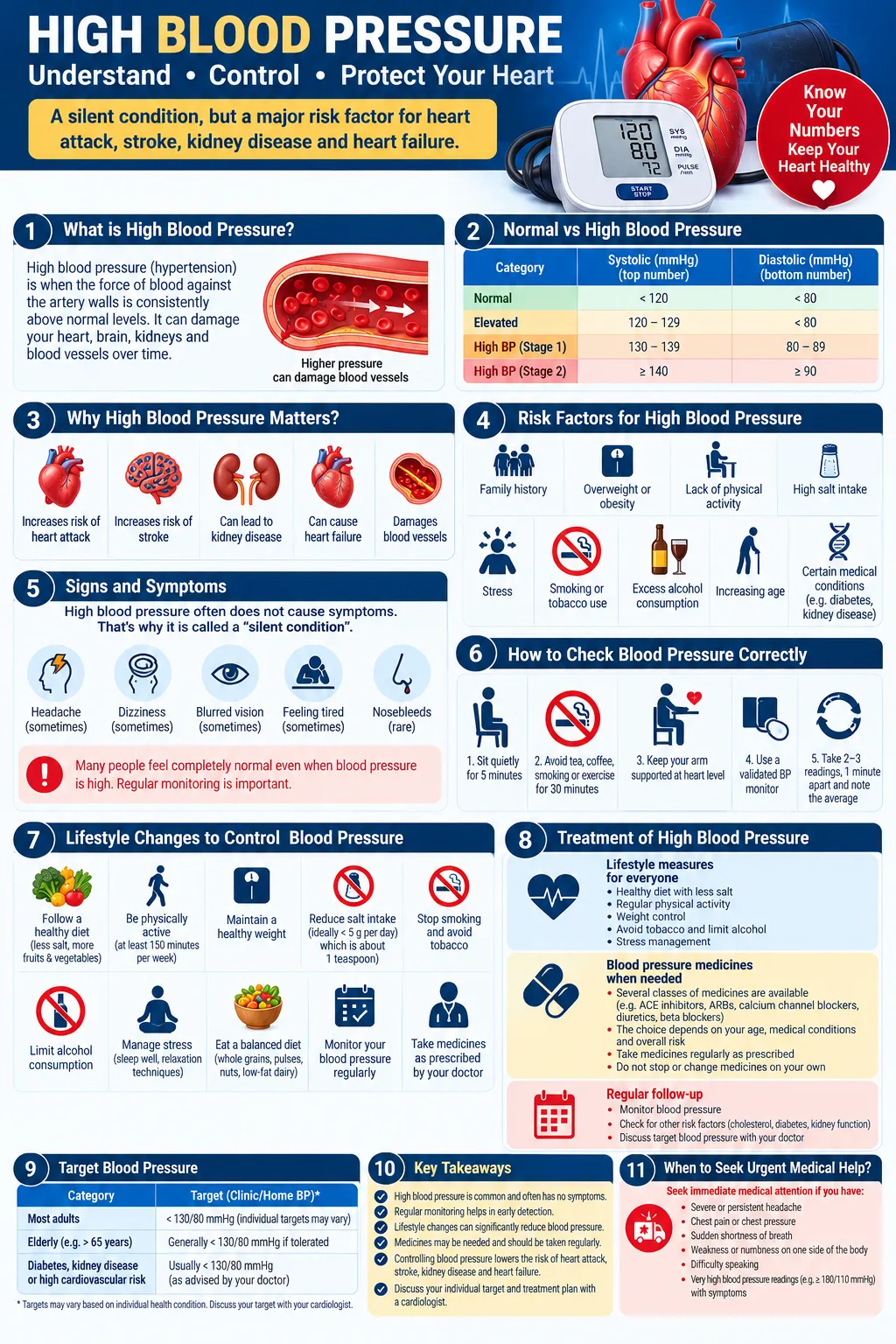
High Blood Pressure: Symptoms, Causes, Treatment and PreventionHigh blood pressure, also known as hypertension, is one of the most common cardiovascul... ( Read More )

Cholesterol Management: A Cardiologist’s Guide to Healthy Cholesterol LevelsHigh cholesterol is a common health concern that can increase the risk o... ( Read More )
CT Coronary Angiography vs Invasive Coronary Angiography: Which Test Is Right for You?When evaluating possible coronary artery disease, two commonly d... ( Read More )