Medical Services
The Largest online database of patient reviews for doctors, facilities and online Appointment.


Coronary Angiography and Angioplasty: Understanding the Difference
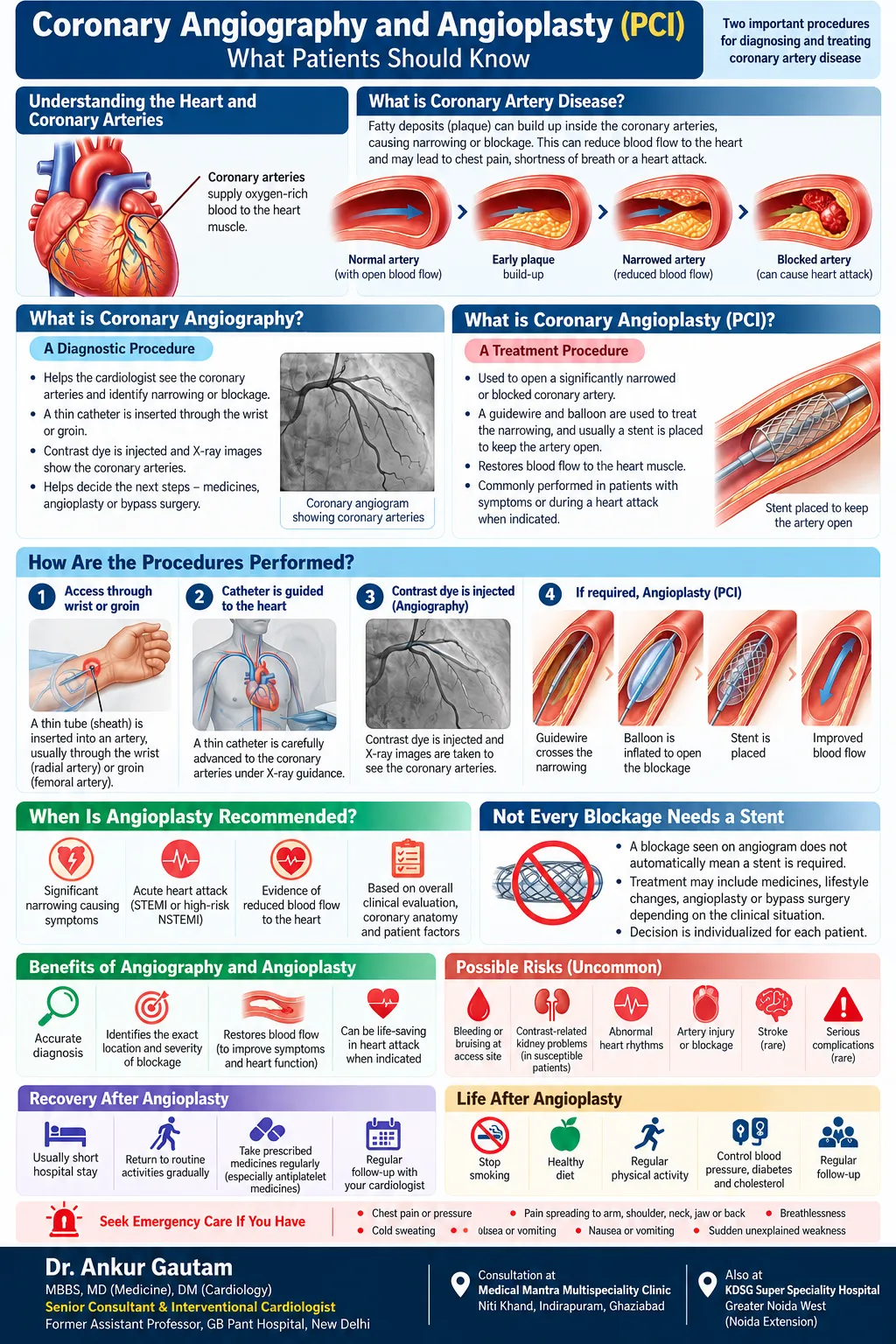
Coronary artery disease occurs when plaque builds up inside the arteries that supply blood to the heart. When these arteries become significantly narrowed or blocked, patients may develop chest pain, shortness of breath or, in some cases, a heart attack.
Two commonly used procedures in the evaluation and treatment of coronary artery disease are coronary angiography and coronary angioplasty (PCI).
Although they are often mentioned together, they are not the same procedure.
Coronary angiography is primarily a diagnostic procedure used to visualize the coronary arteries. Coronary angioplasty, also called PCI (Percutaneous Coronary Intervention), is a treatment procedure used to open an appropriate narrowed or blocked coronary artery.
Coronary angiography is an invasive imaging procedure that allows a cardiologist to see the coronary arteries and identify significant narrowing or blockage.
A thin catheter is introduced through an artery, commonly through the wrist (radial artery) or sometimes the groin (femoral artery). Contrast dye is injected into the coronary arteries, and X-ray imaging is used to visualize blood flow.
The angiogram can help determine:
No.
Angiography helps the cardiologist see the coronary arteries.
Angioplasty is performed when an appropriate blockage needs to be treated.
In some patients, angiography shows that significant intervention is not required and that medicines and lifestyle modification are the appropriate treatment.
Coronary angioplasty is also called PCI — Percutaneous Coronary Intervention.
It is a minimally invasive procedure used to restore blood flow through a significantly narrowed or blocked coronary artery when intervention is clinically appropriate.
During PCI, a catheter and guidewire are used to reach the affected coronary artery. A balloon may be inflated at the site of narrowing to improve the vessel opening, and in most contemporary PCI procedures, a coronary stent is placed to help maintain vessel patency.
A stent is a small mesh-like tube that is placed inside a coronary artery after the blockage has been treated.
Most coronary stents used today are drug-eluting stents, which release medication locally to reduce the risk of excessive tissue growth and recurrent narrowing.
PCI is not automatically required whenever a blockage is found.
The decision depends on several factors, including:
In selected patients with stable coronary artery disease, optimal medical therapy may be the appropriate initial treatment.
However, PCI can be particularly important in patients presenting with an acute heart attack, especially STEMI, where rapid restoration of blood flow can be lifesaving.
A heart attack can occur when a coronary artery becomes suddenly blocked, usually because atherosclerotic plaque ruptures and a blood clot forms.
In patients with STEMI who are suitable for primary PCI, primary angioplasty is an emergency treatment aimed at reopening the blocked artery as quickly as possible.
This is why symptoms such as:
should never be ignored.
If a heart attack is suspected, seek emergency medical care immediately.
Both procedures are generally performed in a cardiac catheterization laboratory.
The cardiologist usually accesses an artery through the wrist or, in selected situations, the groin.
A thin catheter is carefully advanced toward the heart.
Contrast is injected and X-ray images are obtained to understand the coronary anatomy.
Based on the clinical situation and coronary anatomy, the cardiologist may recommend:
Medicines | PCI | CABG (bypass surgery)
A guidewire is passed across the narrowing, followed by balloon treatment and usually stent implantation.
The cardiologist checks blood flow and the final appearance of the treated artery.
In complex cases, additional technologies such as IVUS or OCT may be used to better understand the artery and optimize stent placement.
No.
This is one of the most important things patients should understand.
A blockage seen on an angiogram does not automatically mean that a stent is required.
Depending on the situation, treatment may include:
The appropriate treatment should be individualized based on the patient's symptoms, clinical condition and coronary anatomy.
Both procedures are routinely performed, but they are invasive procedures and are not completely risk-free.
Possible complications include:
The overall risk depends on the patient's health, urgency of the procedure and complexity of the coronary disease.
Recovery varies depending on whether the procedure was planned or performed during an emergency.
After uncomplicated elective PCI, many patients can return to routine activities relatively quickly, depending on their individual condition and their cardiologist's advice.
After angioplasty, medicines are extremely important.
Patients with coronary stents are commonly prescribed dual antiplatelet therapy for a period determined by their clinical situation, along with other guideline-directed cardiovascular medicines.
Do not stop antiplatelet medicines on your own after receiving a coronary stent.
Stopping them without medical advice can increase the risk of stent thrombosis and serious cardiovascular events.
A stent treats a specific coronary narrowing, but it does not cure the underlying process of atherosclerosis.
Long-term heart health therefore remains important.
Patients should work with their treating physician on:
The goal is not only to keep the treated artery open, but also to reduce the risk of future cardiovascular events.
| Coronary Angiography | Coronary Angioplasty |
|---|---|
| Mainly a diagnostic procedure | A treatment procedure |
| Shows coronary artery anatomy | Opens an appropriate narrowed/blocked artery |
| Uses contrast and X-ray imaging | Uses catheter, guidewire and usually balloon/stent |
| Helps determine treatment strategy | Restores blood flow in the treated vessel |
| Does not necessarily involve a stent | Usually involves stent placement in contemporary PCI |
Coronary angiography helps identify coronary artery blockages.
Coronary angioplasty (PCI) is a treatment used to open an appropriate narrowed or blocked coronary artery.
Not every blockage requires a stent.
The choice between medical treatment, PCI and bypass surgery depends on the patient's symptoms, clinical condition and coronary anatomy.
In an acute heart attack, timely primary PCI can be critical when indicated.
After angioplasty, long-term control of cholesterol, blood pressure, diabetes, smoking and other risk factors remains essential.
Dr. Ankur Gautam, MBBS, MD (Medicine), DM (Cardiology) is a Senior Consultant & Head of Department – Interventional Cardiology at KDSG Super Speciality Hospital, Greater Noida West (Noida Extension), and also provides cardiology consultations at Medical Mantra Multispeciality Clinic, Niti Khand, Indirapuram, Ghaziabad.
He is a Former Assistant Professor & Consultant in Cardiology at GB Pant Hospital (GIPMER), New Delhi, with 14+ years of experience in clinical and interventional cardiology.
Coronary Angiography and Angioplasty: Understanding the DifferenceCoronary artery disease occurs when plaque builds up inside the arteries that supply... ( Read More )

Indian Medical Visa from Kenya — Complete 2026 OverviewThousands of Kenyan patients travel to India each year for advanced, affordable medical care ... ( Read More )

Managing diabetes does not mean you have to completely avoid fruits. Fruits are full of vitamins, minerals, and fiber that are important for your heal... ( Read More )

Key TakeawaysTea, turmeric, red wine and tobacco are among the strongest causes of tooth staining in Indian dietsWHO links frequent sugar and tobacco ... ( Read More )